


News

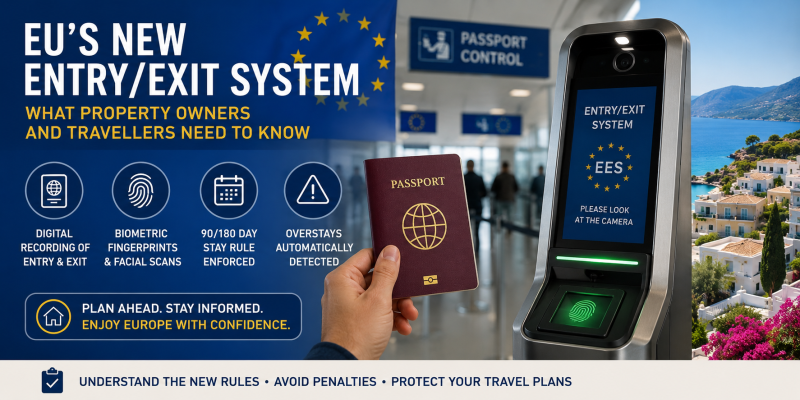
EU’s New Entry/Exit System: What Property Owners and Travellers Need to Know
The European Union is preparing to fully roll out its new digital border monitoring platform, the Entry/Exit System (EES), a move that is expected to tighten enforcement of the Schengen Area’s 90-day stay rule for non-EU visitors.
Recent reports suggest that thousands of travellers have already been flagged for overstaying under trial phases of the system, highlighting how digital border controls are changing travel across Europe.
For property owners, holiday home investors, and long-stay visitors in destinations such as Greece, Spain, Portugal, and Italy, the changes could have significant implications.
What Is the EU Entry/Exit System (EES)?
The EES is a new automated border control system designed to digitally record the entry and exit of non-EU nationals travelling into the Schengen Zone for short stays.
Instead of relying solely on passport stamps, the system will store:
- Date and place of entry and exit
- Biometric information, including fingerprints and facial scans
- Duration of authorised stay
- Automatic alerts for overstays
The goal is to improve border security while also ensuring that travellers comply with the Schengen rule allowing non-EU citizens to remain within the area for only 90 days in any rolling 180-day period.
Why This Matters for Property Owners and Long-Stay Visitors
Many overseas property owners spend extended periods in Mediterranean destinations, especially during retirement or seasonal stays.
In the past, manual passport checks sometimes allowed visitors to unintentionally exceed their permitted stay periods without immediate consequences. Under the new digital system, overstays will be detected automatically.
Potential penalties may include:
- Financial fines
- Increased border questioning
- Temporary entry bans
- Delays or refusal at future border crossings
For owners of second homes or holiday properties, careful travel planning will become increasingly important.
Impact on the Real Estate Market
The stricter monitoring system may encourage some non-EU nationals to explore alternative residency options that allow longer stays within Europe.
As a result, interest could increase in:
- Residency-by-investment programmes
- Long-term visas
- Digital nomad visas
- Tax residency schemes
- Permanent relocation opportunities
Countries such as Greece continue to attract international buyers seeking lifestyle investments combined with residency flexibility.
Greece Remains a Popular Destination
Despite tighter border controls, demand for Greek property remains strong thanks to the country’s climate, lifestyle, and relatively competitive real estate prices.
Popular areas for overseas buyers include:
- Corfu
- Crete
- Athens Riviera
- Peloponnese
- Cyclades Islands
For buyers considering extended stays, professional legal and immigration advice is becoming more important than ever.
Tips for Non-EU Travellers
To avoid issues under the new EES system, travellers should:
- Keep accurate records of entry and exit dates
- Use official Schengen stay calculators
- Monitor total days spent within the Schengen Area
- Seek visa advice before extended stays
- Ensure passports remain valid and up to date
Looking Ahead
The transition to fully digital border monitoring marks a major shift in how travel within Europe will be managed. While the system aims to improve efficiency and security, it also means that compliance with stay limits will be enforced more consistently than ever before.
For international property owners and frequent visitors to Europe, understanding the new rules will be essential for smooth travel and stress-free long-term stays.
 Back